Countdown to Extinction: Getting Through the Guilt with Stoicism and Psychology
The Behavioral Extinction timeline


The bad news is, the few weeks or months it takes can feel like a lifetime.
The good news? You’re not the first or the last. Other people have lived to tell the tale.
What happens when you decide to stop being an emotional first responder?
Or, more accurately, what happens when you decide to stop treating everything like an emotional emergency? When you decide to hold a healthy boundary between you and a friend, colleague, co-worker etc.? Or, what happens when you decide to end that relationship that has long run its course?
Well, in short, it’s going to feel awful.
Key emphasis on feel.
You’re most likely going to be met with a barrage of
“Oh, it’s like that, huh?”
“How could you?!”
“But I need you!”
or even “You’re being really selfish!”
You might even be kidnapped by the hurt, held emotionally hostage by “But I was going to ‘x’!”—whatever it was you’ve been waiting on forever, a favor or even a marriage proposal.

The Natural Order of Fallout
When the people in your life respond this way, it doesn’t mean they’re bad people. Neither are you, for that matter. They’re put-off or hurt because your boundary may have become an inconvenience. Or, they’ve become emotionally reliant on you—which is a two-way street if you’ve dragged things out to spare their feelings. Or, in reality, spare you from having to suffer any sort of fallout. But this is the natural order of things—the cause-and-effect.
…If you can, then, reform the person; but if you cannot, remember that your nature was given to you for this... For you have no right to be offended if a person performs the part of a person.
Meditations 9.42
Pain is a natural part of life. Emotional pain is a natural part of life and we embrace it because, either way, we’re going to feel it.
Stoics hold that virtue (aretē) is the only true good. We’re on board with that. Through the rescuer lens, however, this could easily translate as So long as I’m exercising patience and kindness then my situation is acceptable… Perhaps things aren’t as bad as all that. Even when there’s been insurmountable evidence—perhaps for years—that isn’t the case. When you take that cognitive shortcut—the one that keeps you from having to do the work and feel the effects of another person’s pain—you are failing to follow through on the virtue of Justice (lustitia).
A Failure of Justice
Is it fair to them for you to be disingenuous about who you are, having them believing in a version of you that doesn’t exist?
Justice in the realms of Stoicism means “fairness”, what is just. Is it fair to them for you to be disingenuous about who you are, having them believing in a version of you that doesn’t exist? Or, is it fair to you to suffer unnecessarily when you wouldn’t want that for someone else?
No.
It isn’t Wise or Courageous either. So, ya know, triple-whammy.
To do wrong to one is to do wrong to oneself.
Meditations 9.4

Understanding the Cycle: Positive and Negative Reinforcement
It’s important to recognize that these behaviors are happening in a system of mutually-reinforced behavior. The rescuee has their excessive help-seeking behavior (also called active-passivity) reinforced by getting extra support, help, and care. We call this positive reinforcement. The rescuer gets to escape their feelings of guilt by solving the problem for the other person. Escaping discomfort is an especially potent reinforcement schedule we call negative reinforcement. Thus the cycle is maintained through both positive and negative reinforcement.
So, when a rescuer decides to re-orient and reduce their rescuing behaviors, this can be a real two-for-one deal in emotional pain for the rescuer—as they often have a habit of making someone else’s pain their own. So, they carry both the unwarranted and unescaped guilt of having not rescued, and the distress of the former rescuee at having not been rescued. They might find that, temporarily, they have twice the baggage.
The Extinction Burst: It Gets Worse Before It Gets Better
What happens when a behavior that was previously reinforced at a reliable and predictable interval suddenly stops receiving that reinforcement? People kind of “freak out” and clamour to get that good reinforcement they want so badly. If both parties were previously reinforced, we’d expect to see a temporary increase from them, meaning more urgent and dramatic help-seeking behaviors from one party—and more pronounced and intrusive guilt in the other party. This is definitely a case of it gets worse before it gets better.
Psychologists call this a Behavioral Extinction Burst: temporary, predictable increase in the intensity, frequency, or duration of an unwanted behavior when it is no longer reinforced. While you see yourself painfully transforming into a free butterfly, they may see you transfiguring into The Thing: someone who looks exactly like the person that they relied on but is now treating them with the clinical indifference of a predator. To a Stoic, clinical indifference isn't cruel. It is apatheia: freedom from being overcome by irrational passions.
It isn’t easy being someone’s figurative monster. But, over time, that fades.

It isn’t easy being someone’s figurative monster. But, over time, that fades. Maybe they’ll see you in a better light, maybe they won’t. Maybe they’ll even have a different version of what happened. These are preferred indifferents (proēgmena), however: what we prefer to happen but we should not require it.
Sure, we would prefer they understand and arrive at the conclusion that it was for the best. We would also prefer they not feel hurt but that’s not real life. And when real life proves itself real, we should be ready for it—and ready to say, “It is nothing to me.” (Epictetus) Not that it means nothing but that it’s not your business to orchestrate the way they feel just so you can feel better about the whole thing. As cliche as it may sound, though, time heals. In The Stoicism Workbook (New Harbinger Publications) we compared the embracing of this sort of adversity to cold exposure:
While it is not a necessary component of the philosophy, it is worth mentioning that exposure to cold stimulates the body’s natural response to stress, which leads to the release of hormones such as adrenaline, noradrenaline, and endorphins. The same happens when we initially take a dip in the pool or the ocean. It’s quite a shock but the more we bathe in the icy cold water, the more we adapt. The same is said for stressful situations. They will arise but if we are willing to stay and wade, the initial jarring feeling wears off, enabling us to swim instead of run out.

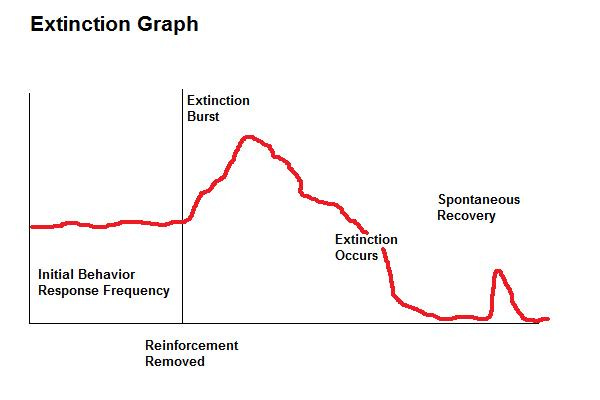
So, here’s how what the actual Behavioral Extinction timeline looks like.
Or…
…hang on…
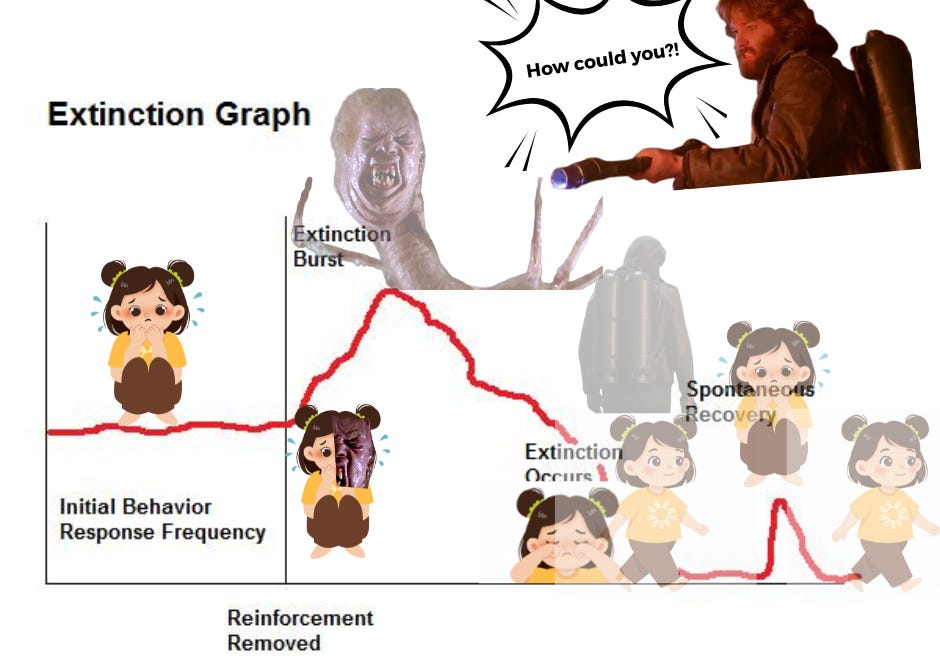
So, as you can see, the initial response frequency is where you may be at now: repeating the same pattern of hiding how you feel in efforts to spare others and yourself from the inevitable fallout.
When you decide to switch course, removing thinking patterns that reinforced the behavior (such as the irrational belief that they need to be rescued from their own feelings), the other party in the situation begins to take notice. Then, when it bursts, you become the thing that takes them by surprise and, quite possibly, disappoints them. (many of us have a hard time with that) As time passes, however, where the graph gradually descends, the extinction of the behavior occurs, some tears may be shed, and you carry on with a newfound mindset.
Behavioural patterns aren’t formed overnight. They’re formed from years of experience and shaped by external influence. So, when we suddenly decide to quit, we go through emotional withdrawals. A spike is bound to happen—the spontaneous recovery of the behavior.
How Do We Get Through This
The most important tool in this situation is information. You need to mentally prepare yourself for a bumpy ride…

…we’re choosing a temporary increase in discomfort as a way to reduce overall long-term discomfort: short-term pain, long-term gain.
In Dialectical Behavior Therapy, there is a commitment strategy called freedom to choose and absence of alternatives. You don’t have to do this. It is your choice. At the same time, you’ve tried everything else and that didn’t work. So, we’re making a deal: we’re choosing a temporary increase in discomfort as a way to reduce overall long-term discomfort: short-term pain, long-term gain.
This is where the wisdom of one-day-at-a-time, or rather, one-moment-at-a-time comes, into play. Also, it is important that you stick to this. There is a behavior reinforcement schedule called variable-ratio. It’s like a slot machine, and it is incredibly habit forming. If you set a boundary, but only stick to it some of the time, that can an unintentionally increase the very behavior we are trying to extinguish.
Holding the Line
Initially, you’re both going to feel worse, and you’ll have moments where you regret your decision to change.
Hold the line. You can do this.
That guilt will increase, peak, and decrease all on its own. And on the other side of that hill is freedom. Focus on getting to the other side of it, knowing it will take however long it takes, but it will work. And then focus on reinforcing within yourself the new behavior that you want to see more of.
Reinforcement can be your friend if you learn to use it to cultivate the kind of life you want to have.
Our book The Rescuer Trap (New Harbinger Publications) is slated to release Fall 2026! Subscribe for updates!

Great info tonyz
M y pleasure,sendmore